Showing posts with label beauty. Show all posts

Friday, March 30, 2007

Post by post...


this is the rest of this, ....

don't know what to say really.
3 hours
to the biggest battle of WKSide
all comes down to today.
Either i heal as a person
or I’m going to crumble.
Post by post
day by day
till it’s finished.
I’m in hell right now, mister,
believe me and
I can stay here
and get the shit kicked out of me
or i can fight my way
into the Side.
I can climb out of hell.
One post, at a time.

Now I can do it for you.
I'm young.
I look around and I see beauty
and I think
I mean
I included every single thing I could find.
I uh....
I pissed away all my time
believe it or not.
I chased off
anyone who I believed could give an answer.
And lately,
I can't even stop reading the blog I see in the screen.

You know when you are still young in life
things are still beautiful.
That's, that's part of life.
But,
you only learn that when you start seeing things differently.
You find out that beauty is just a game of experiences.
So is this Blog.
Because in either game
blog or Wk Side
the margin for error is so small.
I mean
one half post too late or to early
you don't quite make it.
One half second too slow or too fast
and you don't quite see it.
The answer WK needs, is everywhere on this blog.
It is in every post of the blog
every link, every picture.

On this blog, i fought for that post
On this blog, i tear myself, and everyone around me
to pieces for that post.
I CLAW with my finger nails for that post.
Cause i know
when i add up all those posts and send it
that's going to make the fucking difference
between Qualifying and Failing
between WkSide and What’s next.

I'll tell you this
in WkSide
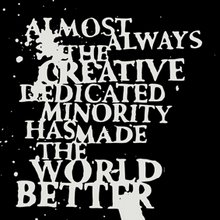
it is the guy who is willing to create
who is going to win that position.
And I know
if I am going to have any chance in WK anymore
it is because, I am still willing to create, and think different for that post
because that is what Beauty is.
The life itself.

Now I can't make you take me.
You gotta look at all the projects.
Look into these projects.
Now I think you are going to see people who want Wk side as I do.
You are going to see people
who produced stellar work for this scheme
because they know when it comes down to it,
you are gonna do the same thing for them.

That's the WkSide team, gentlemen
and either I hear a phone call in a while,
or i will fail as individual.
That's WkSide guys.
That's all it is.
Now, whattaya gonna do?

Thursday, March 29, 2007

Juxtaposition by un Genio!


Here is an interesting article I found about a famous and well respected Artist. For me a Genius; Signore Leonardo Da Vinci!

Very few artists other than Leonardo appear to have felt a life-long need to articulate their ideals of beauty in drawings, along with seemingly endless variations on the theme of supine ugliness, and certainly none did so with comparable persistence or coherence of vision. As the great master's words intimate, 'beauty (bellezza) and ugliness (brutteza) appear each more powerful when seen in contrast, one with the other'. (1) In his conception of the 'ages of man', Leonardo would often juxtapose the ideally perfect beauty of youth with the grotesque deformity and decay of old age, because--as he inscribed below the sketch of an old hag--'a beautiful thing that is mortal passes and does not last'. (2) Between the late 1480s and the late 1490s, Leonardo's preoccupation with the human face (its proportions, expressions, and deterioration with age) resulted in especially penetrating physiognomic studies, and the sum of these drawings--which are notably heterogeneous in style and medium, for here one needs to think broadly about content, and include, for example, the pen and ink grotesque heads, as well as the chalk studies for the apostles in the Last Supper--appears to indicate that Leonardo had arrived at highly cogent, unified theories about gesture, some of which he probably covered in his lost treatise on painting and human motion. (3) In his role as a theorist of painting, Leonardo repeatedly stated that the two most formidable challenges facing the good painter were the portrayal of man and the intentions of the mind; in his lost Libro A of 1508-10, he had variously called the latter the 'passioni dell'anima', the 'accidenti mentali', and the 'moti mentali', and the very eclecticism of his vocabulary seems to indicate that he was both relying on different sources and returning to his own previous ideas, the earliest of which he may have formulated in 1490-92. (4) It is clear, therefore, from both his drawings and writings that the concern with the physical and psychological dimensions of gesture was a lifelong preoccupation.
A memorable and groundbreaking exploration of this aspect of Leonardo's work was provided in the recent exhibition, 'Leonardo da Vinci: The Divine and the Grotesqque', selected by Martin Clayton from the unparalleled holdings of the six hundred or so Leonardo drawings at the Royal Library, Windsor Castle. (5) As a scholarly contribution to the vast field of Leonardo studies, this exhibition was remarkably innovative in conception, and treated the material with extraordinary intellectual elegance. It displayed a number of drawings by Leonardo that have either not previously been exhibited, or very rarely so (for example, nos. 10, 11, 23, 49, 57, 67, 68-70, 75), and made the kinds of imaginative visual connections across themes that very much embody Leonardo's own method of drawing by analogy and permutation. The exhibition brought together seventy-six drawings (one, hors catalogue, RL 12576) that were arranged in eight sections designed to highlight the various dimensions of Leonardo's thought. In this regard, the visual experience of the display may have had a greater clarity of structure than the fine, accompanying scholarly catalogue. A monumental sheet in pen and ink of around 1478 (no. 1), portraying ideas for a nursing Madonna and Child with the infant St John the Baptist, along with numerous sketches and doodles of heads of men, women, and animals in profile, served as a centrepiece of the exhibition; it helped illustrate in germ form many of the recurrent themes in Leonardo's work over the next forty years of his career. An introductory section of thirteen drawings (nos. 2-14), entitled 'The divine body', cast a wide conceptual net over a great diversity of endeavours. (It is worth pointing out that 'divine' is not a term Leonardo himself used in describing physical beauty or bodily perfection.) Here represented were Leonardo's exploratory drawings of the body, whether human or equine, and these also included a variety of different drawing types (studies of anatomy, proportion, and of purely artistic intent). Although it perhaps wove together a few too many strands with an insufficient number of examples, this section on the 'divine body' provided, nevertheless, an entirely necessary springboard for the more integrated display of drawings that followed of Leonardo's ideal types of women and men, of bodily and facial expression (as was magnificently evident in the studies for the apostles in the Last Supper), of grotesque facial deformity, of portraits, and of the magical transformations from real to imagined creatures. A section on 'Fantasy and costume' (nos. 62-75), which included a number of Leonardo's designs for courtly spectacles, provided an arresting finale for this well-thought-out exhibition.

Thursday, March 22, 2007

Storia della Belleza...


Many people associate beauty with Art. Art is a form of expression, and when an Artist creates something from point zero one of his main visions is to create something that he believes is beautiful. Uberto Eco is one of the most important medievalist, semiotician, philosopher and novelists of the world. In One of his books "History of Beauty" he is showcasing beauty that comes from art. This work on the history of beauty is aimed at a general audience rather than a specialised one, and as such it abounds more in beautiful works of art and illustrations rather than scholarly analysis of art itself. However, it still contains an excellent history of the idea of beauty, and how artists through the ages have tried to implement somewhat abstract ideas, while philosophers and theologians have abstracted from art to apply artistic and creative terms to entities such as Platonic Forms or God.

One of the most interesting developments in the history of beauty was the identification of beauty with reality as it was in itself. Platonists identified the beautiful with the Good or the One, and Christians planted these ideas onto God. The notion that God was the most beautiful entity that existed, that God could be represented in art, and also that the cosmos in many ways is God's work of Art, expressed itself in many great works of art, poetry and architecture in the medieval period.

With the Renaissance, the concept of beauty became more grounded in human and earthly realities, and one sees far more focus on the beauty of material objects, nature, and people, as they are rather than their ideal nature. Art becomes more and more focused on the material world until the 20th century when in the era of late capitalism, art itself has become a consumable commodity and the chief virtue of art seems to be to cause pleasant feelings to arise in the consumer (something Andy Warhol satirises a lot in his works of art). Yet even in this period, artists still manage to create works of creative beauty which capture both the beautiful and the ugly, as we now see them.